
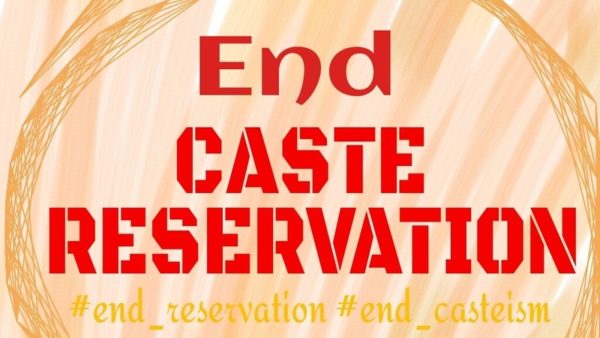
Reservation – The word kindles hope for some people and anger in some people. Both are justified. The idea of reservation came into existence with a purpose to provide opportunities to the downtrodden. With many metamorphoses to the original rule, the present day reservation system is a much-debated issue. The topic is always a subject of hot debates and bandh and so also the bandh called on 10th April 2018 which is a strike against reservation policies.
History of Reservation
The history of reservation dates back to pre-independence. The Maharaja of Kolhapur, Shahu had introduced reservation for non-Brahmins during his tenure in 1902. People coming under the reserve category were entitled to free education and jobs thereafter along with few other entitlements. The British Raj continued this reservation system which was endorsed by Government of India Act, 1909.
Post independence, reservation saw many amendments. The only intention of the reservation was to give a respectable position for the SC and ST who were dominated by the upper caste people. They were, educationally, economically and socially poor class and reservation gave them a chance to get educated, get into the mainstream in respect of jobs. This was justified at that time as the entire community was struggling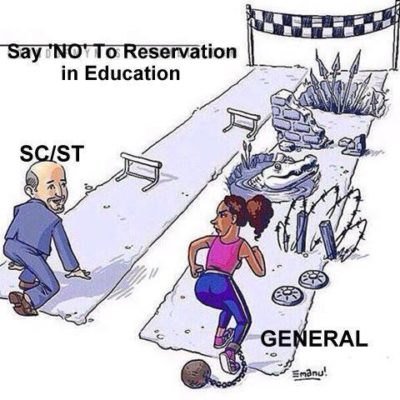 to come up.
Reservation Policy – An Overview
There are umpteen number of facilities a person gets if he falls under the reservation quota. Starting from education wherein the person gets students aid, reservation is there in every walk of his life. A large quota of Government and public sector jobs are reserved for them. They get quotas in elected bodies as well including Parliament seats. 15.47% of Parliament seats for SC/ Dalits and 8.66% for ST/ Tribes, totaling to 131 out of 543 seats come under reserved category. (Source Wikipedia- https://en.wikipedia.org/wiki/Reservation_in_India) . This shows the vastness of the reservation’s arms.
Present scenario of Reservation
After 71 years of independence, the reservation is still being used, rather misused by the people in power for their own advantages. Reservation is still based on caste and not on financial status. With the result, even though the people coming under reservation are rich and well placed are getting all favors from the Government whereas the really deserving, upper caste people, though financially weak, are struggling with no facilities for them.
There are a big hue and cry all over the country to make reservation caste-free and provide facilities to the deserving based on income and financial status.
Ill effects of Caste based reservation
Caste-based reservation was a requirement when it was implemented. But with the development India has seen over the years, the caste-based reservation has more disadvantages than advantages. The worst ill-effect of this system is ‘brain drain’.
 A deserving student, who is hardworking, intelligent does not get opportunities on his merits because of the reservation quotas. This naturally makes him find other options and turning away from India for a better future is the most sought option. Meritorious students are running away from India and discovering their future in other parts of the world. They get opportunities and recognition and make a fantastic living.
But back in the homeland, the strings of administration is falling into the hands of people who have climbed the heights using reservation. I am not talking about those who have brains and deserve the positions they got into. I am talking about those who have procured medical and engineering seats, got into administrative jobs just because of the caste they belong to. What progress can we expect from those who have occupied the positions only because of the caste they belong to?
The solution to this problem is simple. Provide free basic education to all. Provide free education to all the meritorious students who fall under financial poor background. Let there be no reservation based on caste. Let there be competition between brains so that they will fall in place based on their IQ. Why can not we implement such a simple solution which is the basis of overall development?
Here is an example of how reservation affects general merit students.
| Category | Merit Cutoff Percentile |
| General/UR | 99.0014978 |
| OBC (NCL) | 97.4205359 |
| SC/ST | 94.1220114 |
Source: https://medicine.careers360.com/articles/aiims-mbbs-cut-off
The difference between general merit and SC/ST is 4.88 percent. There will be hundreds of general merit students who will be denied seat within this percentage. This is just one example of many.
AIIMS MBBS Cut off 2016 – Institution wise Last Rank Cutoffs
| Name of AIIMS Institution | General | OBC | SC | ST |
| All India Institute of Medical Sciences, New Delhi | 37 | 256 | 1,138 | 2,825 |
| All India Institute of Medical Sciences, Bhopal | 1,022 | 1,170 | 14,170 | 20,498 |
| All India Institute of Medical Sciences, Bhubaneswar | 1,078 | 1,034 | 16,865 | 13,905 |
| All India Institute of Medical Sciences, Jodhpur | 871 | 1,946 | 8,151 | 18,701 |
| All India Institute of Medical Sciences, Patna | 2,949 | 2,130 | 17,198 | 23,845 |
| All India Institute of Medical Sciences, Raipur | 1,099 | 1,991 | 16,297 | 23,929 |
| All India Institute of Medical Sciences, Rishikesh | 1,045 | 2,095 | 18,049 | 20,140 |
Source: https://medicine.careers360.com/articles/aiims-mbbs-cut-off
Here also one can see the difference in allotment of seats between general merit and Reservation students.
Protests have been going on against caste-based reservation. The recent Bharat bandh was called to protest against caste-based reservation system. Many people are under the notion that it is a strike against reservation. It is not so, it was a strike against anti-reservation based on caste. People in power are misusing this concept of reservation for their selfish purposes and common people are falling prey to this.
Nobody is against reservation, but let it be based on economic criteria and not on caste. Let all meritorious students get an equal chance.






From Caste to Unity: Rethinking the Varna System
Can a system once intended to organize society become a tool of exploitation and division?
Indian history offers a complex answer through the evolution of the varna system.
Originally, the varna system in early Vedic times was based on one’s karma (work)—whether it was contemplation, protection, production, or service. It aimed at maintaining balance and cooperation. However, over time, this flexible structure became rigid and birth-based, where many hardworking communities were labeled impure or inferior.
The alliance between religious and political elites reinforced this transformation. To preserve their authority, some groups linked their dominance to divine will, presenting this structure as sacred and unchangeable. This not only ensured control over resources but also created deep-rooted psychological and social hierarchies.
Social Fragmentation and Historical Consequences
The combination of caste divisions and internal conflicts weakened the social fabric so much that, between the 12th and 16th centuries, foreign invasions caused immense destruction. Many ruling families were wiped out, their wealth looted. Women suffered atrocities, and tragic events like jauhar (mass self-immolation) occurred. These were not isolated incidents—they reflected the long-term consequences of a divided society that lacked unity in times of crisis.
The Misuse of Spirituality: When Religion Serves Power
Spirituality—meant to uplift and guide toward justice—gradually became a tool to maintain power structures. Vedic hymns, originally rooted in wisdom and introspection, were reinterpreted by some to justify caste hierarchies as divine order. This distortion continues today in caste-based politics and social discrimination.
The Zoroastrian Parallel: A Simpler, Inclusive Model
Many people note similarities between early Vedic and Zoroastrian traditions. In the Zoroastrian text Avesta, society is divided into three karma-based roles: spiritual guides, warriors, and producers. Unlike rigid caste divisions, these roles were flexible and not based on birth.
This comparison suggests that spiritual systems need not be oppressive—they can be inclusive and practical. The degeneration of the varna system appears to be an internal development, not an inherent flaw in early traditions.
In essence, whenever a system deviates from its original intent of harmony and justice, it risks becoming a source of conflict. The lessons of history urge us to return to the values of equality, unity, and compassion.
Very nice post I like it a lot Thank you