
Boons and curses are two sides of the same coin. And in a religion where gods and goddesses galore, the count of boons and curses far exceed a recordable number in Hinduism. However, there were some that came to be regarded as extremely important for the culture as it paved the way for several modern-day rules that we still follow.
Migrating from the Aryans in Central-Asia, Hinduism has spread across India and other neighboring countries over time. Hinduism is considered to be the oldest religion in the history of mankind. It has existed for centuries and through several past and present civilizations that were and still are based on its principals and teachings. 4000 years later and 900 million followers’ aside, it is still the most mysterious and intriguing mythology to ever exist.
The stories of Hinduism have flown through many paths including written and oral medium. It wraps us in the stories of the many gods and goddesses, their love, their rage, their battles and even their pleasures. We have grown up looking in their direction for advice on idealistic life, for love and for support. Their presence has shaped our lives in an intangible manner. All the different folklores form our guiding light.
The most famous folklores encompass the tales of boons and curses. Several of these still echoes in our lives with even the modern civilization bowing to them. These are kept alive not because of the mystery surrounding them alone, but also because of the message it conveys and the philosophy behind it.
The Curse of the Ketaki flower
One such curse was the curse of the Ketaki flower. The Ketaki flower, also known as Kewra or screw pine, carries significance in Hindu lore. It is highly fragrant and is even used for making perfumes and aromatic oils. Along with its high commercial use, this flower also holds value when it comes to the myth behind why it is never offered to gods in spite of being extremely beautiful and having nice fragrance.
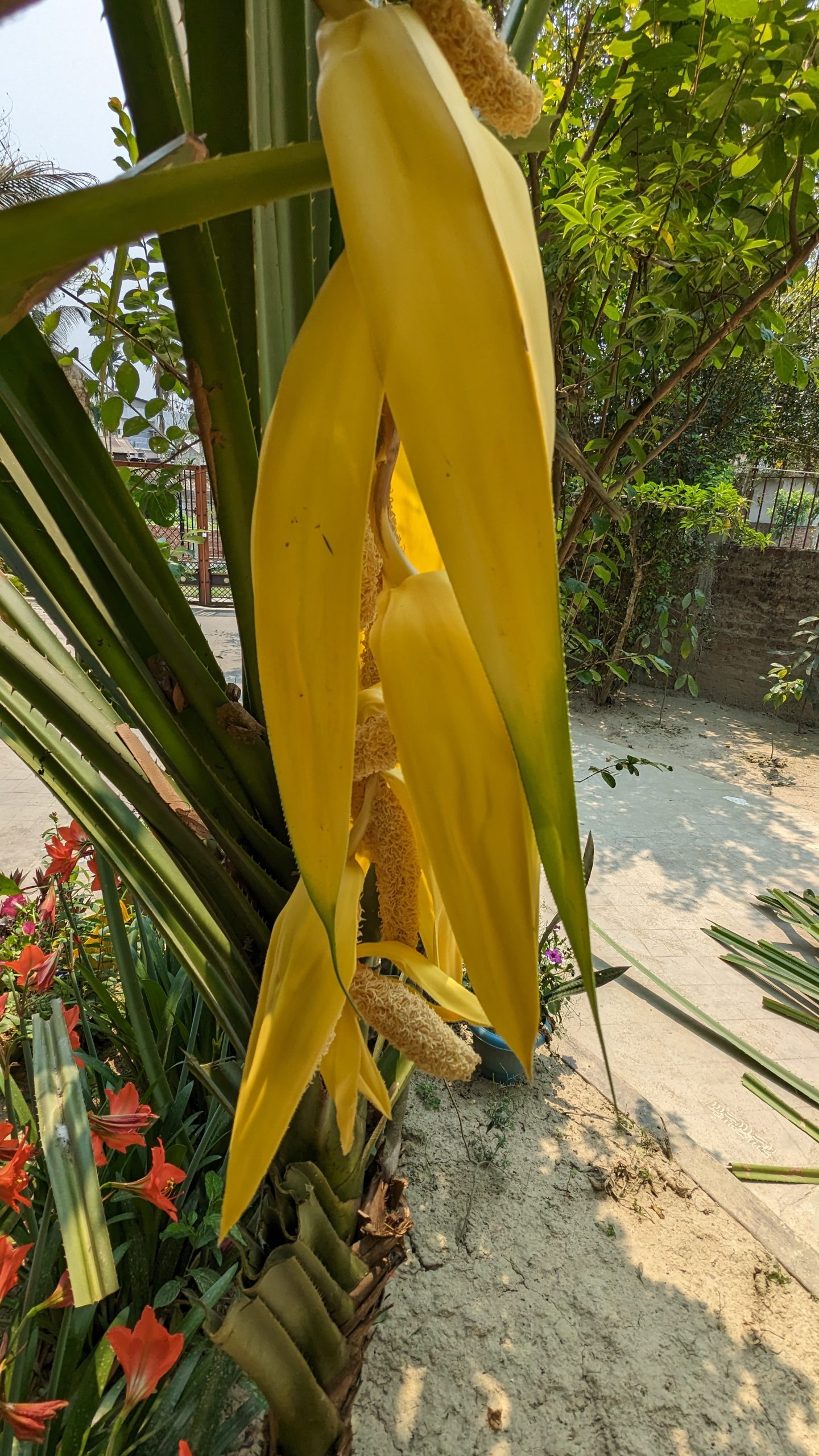
Ketaki Flower
At the dawn of the entire universe, the holy trinity was born. Lord Brahma was the creator of the universe and all things living. Lord Vishnu was appointed as the protector of the realm, the preserver, the guardian. Lord Shiva was the destroyer, the one in-charge of demolishing the evil and before the good was re-created. All the three worked equally to maintain balance. Yet it didn’t take long for discord over supremacy to occur.
Lord Brahma and Lord Vishnu got engaged in an argument regarding who was the superior god. As the argument grew intense, the two gods decided to take it to the battlefield. The Devas who were horrified of what would ensue if the two fought rushed to Lord Shiva and asked for his help.
According to the Linga Purana, the Shiva lingam is the representation of the infinite nature of Lord Shiva himself. At one end is the Earth while the other end spreads into the wide endless sky towards the boundless universe. This lingam was to decide the supremacy of one God over the other. As a test, they would have to find the Aadi, the top of the lingam and the Antya, the end of the lingam.
Lord Vishnu took the form of a boar while Lord Brahma turned into a swan. Together they decided to fulfill the task given by Lord Shiva. Vishnu kept digging and descending, and Brahma flew higher. After eons had passed and Vishnu had still not found the end, he admitted defeat. Brahma on the other hand decided he would play a trick on Shiva.
He came across the Ketaki flower on the way up. Lord Brahma asked her to bear false witness and lie to Lord Shiva that she was on top of the lingam where Brahma had found her. The Ketaki flower agreed. Together they tried to trick Shiva into believing that Brahma had found the Aadi. But Shiva, the omniscient, was aware of their malice and became infuriated. He cursed Lord Brahma that he would never be praised nor would there ever be a temple built in his name. Along with that he cursed the Ketaki flower that she would never be offered to any gods or goddesses. Hence, she lost her importance and was barred from all religious engagements.
This story is not just an old man’s story. It is a fable that teaches about honesty and the misfortunes that would befall if one became greedy. It teaches that even if you are as beautiful as the Ketaki flower, you will suffer if you go down the path of avarice.
Parashurama’s Curse to Karna
Karna, born of Kunti and the Surya, was brought up by Adhiratha and Radha. Though born a Kshatriya, he was known as shudra because he was brought up by the carpenter and his wife. In spite of that Karna was born a warrior and his Kavacha, the golden armor, and the Kundala, the golden earrings, with which he was born, a gift from his father, Surya. When he discovered that he was an adopted child and not really a shudra by blood, Karna decided to leave the Hastinapur in search of his true calling.
He initially approached Dronacharya to learn the art of warfare from him. However, his request was denied when guru Drona found that Karna was brought up in shudra household. Determined to not give, Karna decided to meet the Brahman warrior, Parashurama. Parashurama was notorious for having killed all the kshatriyas in an act of revenge for his father’s death.
On his ardent request, Parashurama and Karna met. Knowing that the great sage loathed the Kshatriyas, Karna lied to him that he was a Brahmana. Even though he was aware that he might be killed or cursed, his desire to learn archery was unquenchable.
Parashurama was pleased with his humility and decided to be his guru. Parashurama and Karna spent years in archery and martial training. On one afternoon during his training, Parashurama instructed Karna to get him a role of deerskin which he would use as a pillow. Karna offered him his thigh and asked him to rest with his head on it. Parashurama then laid his head on Karna’s lap and fell fast asleep.
As Karna sat there, a bee stung his right thigh and dug into his flesh. In fear of waking his guru, he endured the pain without moving and not even shaking. Blood oozed out and touched Parashurama’s face. On waking up he was startled. He could not believe that a soft Brahmana could endure the pain of that intensity. He was enraged when he found out that Karna was a Kshatriya and was deceived by him.
Karna fell to his feet and begged for his forgiveness. Parashurama and Karna were irreconcilable. Parashurama refused him mercy and cursed him that whenever he would be in desperate need of his knowledge in arms, his memory would fail him. All the learnings he acquired would not come to his mind, making him an ordinary man.
This curse took effect during his battle with Arjuna. On the last day of his battle, he forgot the mantra to initiate his Brahma-Astra. Thus, the fall of a great man lay in the way he handled his fate by lying to his teacher.
The Curses of Ahalya and Indra
The Ahalya’s story exemplifies the life of high cast chaste Hindu woman whose life spiraled down due to the people around her and the customs of the Vedic society. According to the Ahalya story, she was created by Lord Brahma to counter the pride of Indra’s most beautiful creation, Urvashi. Ahalya was considered to be Brahma’s most beautiful and prized creation. Ahalya in Sanskrit means untainted.
Brahma sent Ahalya to live with Rishi Gautam till she reached puberty. After she was grown up, the sage returned Ahalya to Brahma, who was so pleased with him and Brahma blessed Ahalya to be his wife. Lord Indra had always been very much attracted to Ahalya owing to her innate beauty. Upon receiving the news of her marriage, he plotted to have a reunion with her.
He disguised himself as Gautama and entered the hermitage when the sage left. While in his deceptive form he urged Ahalya to make love. In spite of realizing that it was not her husband, she was taken aback by the fact the king of all gods had taken an interest in her. Seduced and charmed, she gave in. They made love to each other, during which time the sage Gautama returned and caught them in the act.
Furious and enraged, he cursed Lord Indra to be covered with what he desires most, a thousand vaginas all over him, and lose his manhood as well. For a woman who turned infidel in pride of her own beauty and knowingly committed a sin, the sage cursed Ahalya to turn into stone until Lord Vishnu’s feet touched her.
A few centuries later when Lord Rama was on road to Maithili, the dust from his feet landed on the stone, and Ahalya was transformed back into her original form. After achieving redemption by the grace of Lord Ram, she returned to her husband who had now sought shelter in the Himalayas. A story of vanity and greed, it teaches mankind that downfall is in tow if you give in to pride and greed.
While these are from older times, a curse which is said to be valid till present day, invokes curiosity. It is a curse that befell on the Mysore Rulers. During 1612 the Mysore kings conquered Srirangapatna and the queen at that time Alamelamma, jumped into a well while trying to escape being caught by the Mysore kings. While jumping she cursed Mysore Dynasty – ‘Let Malangi become a whirlpool, Talakadu a sand bed and let Mysore kings not beget children’.
Her curse seems to be working till date and only the adopted children of the family will have their own children. This is seen to be true till date and it is interesting to see that Talakadu, which is on the banks of river Cauvery is filled with sand, which are living examples of Curse.
Curses are true or not nobody can conclude, but some instances are beyond our logic and make us think about them.